Why Atlassian’s share price rose, and what it executed well
Research date: 1 October 2026
Scope: The August 2026 repricing of Nasdaq-listed Atlassian (TEAM), after Q4 FY26 results released on 6 August. This is not investment advice.
Method: Reviewed Atlassian’s Q4 FY26 results and shareholder letter, then checked the market reaction and consensus comparison against Reuters and Nikkei Asia. Company-supplied product-adoption metrics are labelled as such.
Executive conclusion
The rally was primarily a reset of an overly bearish AI-disruption thesis, not a reaction to one earnings beat. Confidence: high on the facts, medium on the causal weighting. Reuters reported that TEAM rose 35.2% in extended trading after the release, while Nikkei described shares as up roughly a third as the results eased concern about Atlassian’s position in the AI era.[^1][^2]
The evidence investors received was unusually coherent:
- Q4 revenue, adjusted EPS and Q1 guidance all exceeded the published analyst consensus.[^1]
- The strategically important Cloud business accelerated to 31% year-on-year growth, while subscription ARR grew 23% and contracted future revenue, RPO, rose 44%.[^3]
- Atlassian turned a Q4 FY25 GAAP operating loss into a 12% GAAP operating margin, showing its growth could carry real operating leverage.[^3]
- Management offered a credible mechanism for AI to expand, rather than shrink, its seat and platform opportunity: enterprise context, workflow integration, agent orchestration and bundled collections. The usage and monetisation evidence for this mechanism remains company-provided rather than independently validated.[^4]
The conclusion is narrower than “AI is working”. The market appears to have revised the probability that AI destroys Atlassian’s economics. It did not receive proof that AI monetisation or FY27 reacceleration is locked in.
What moved the market
The hard numbers beat expectations
Atlassian reported Q4 FY26 revenue of US$1.766bn, 28% higher year on year, versus an LSEG consensus of US$1.66bn. Non-GAAP diluted EPS was US$1.87, versus a US$1.50 consensus. Its Q1 FY27 revenue guide of US$1.705bn to US$1.715bn also exceeded the US$1.66bn consensus.[^1]
Those beats mattered because the market had been pricing a weaker business. A beat alone does not explain a 35% move. The results also showed Cloud revenue growth accelerating to 31%, to US$1.213bn, and Q4 GAAP operating margin reaching 12%, from -2% a year earlier.[^3]
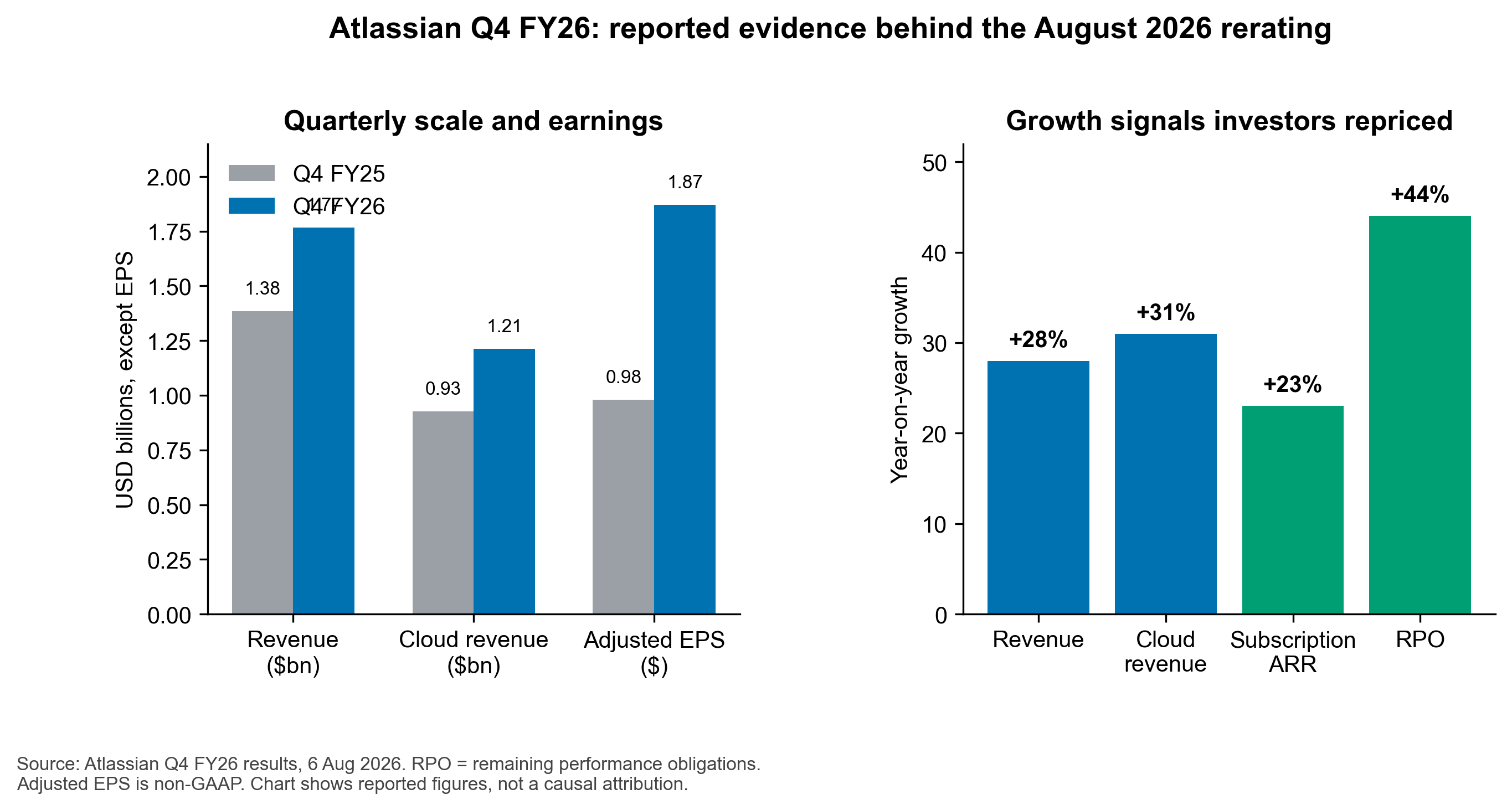
Figure 1. Reported Q4 FY26 performance. The figure uses Atlassian’s 6 August 2026 results. It shows evidence that informed the rerating, not a model that assigns causal weights to the share-price move.
The result challenged the AI bear case
Nikkei’s contemporaneous reporting explicitly framed the move as reassurance about Atlassian’s AI position.[^2] The financial evidence supports that reading: customers were committing more, not less, to the platform. RPO, a measure of contracted revenue not yet recognised, rose 44% year on year to US$4.817bn.[^3]
Atlassian’s explanation is that AI agents become more useful when grounded in a graph of enterprise knowledge, work, communications, code, assets and people. That is a differentiated product thesis, not a financial fact. The evidence of traction is therefore mixed:
- Company-provided: more than 80% of Fortune 500 companies use Rovo; Rovo-assisted actions rose more than 50% quarter on quarter; and Rovo adopters grew ARR more than twice as fast as non-adopters.[^4]
- Observed financial outcome: Cloud growth accelerated and large enterprise commitments increased, as reflected in revenue and RPO.[^3]
The first set shows correlation, not causality. Adopters may already be Atlassian’s larger or faster-growing customers. The second set is more reliable but does not isolate Rovo from core Jira, Confluence, JSM, sales execution or Cloud migration.
What Atlassian did right
1. It made Cloud the growth engine before the market forced the issue
Atlassian reported 31% Cloud growth in Q4, ahead of 28% total revenue growth. It has also committed to ending most Data Center products on 28 March 2029, creating a clear migration path rather than maintaining two product strategies indefinitely.[^3][^5]
That choice matters strategically. Cloud is where Atlassian can ship AI capabilities, cross-product workflows and usage-based features continuously. It moves the business towards recurring subscription revenue and a closer customer relationship. The caveat is that the transition also creates a near-term comparison problem. FY27 guidance calls for Data Center revenue to fall about 17% and total revenue growth to slow to about 13%.[^3]
2. It packaged products around enterprise workflows rather than selling AI as a standalone feature
The company’s collections strategy combines core work-management products, service management and Rovo. Management says Teamwork Collection customers use more than twice the AI credits per user and deploy twice as many active agents as standalone-product customers, while Service Collection growth accelerated.[^4]
That is a sensible commercial shape. Enterprise buyers need secure, governed workflows spanning teams and systems. A bundle can increase adoption, seat expansion and average revenue per user more reliably than an isolated chatbot. Still, the quoted usage figures come from Atlassian, so treat them as directional evidence until retention, expansion and paid AI revenue become separately disclosed.
3. It paired the growth story with genuine cost discipline
Q4 GAAP operating income was US$211m, compared with a US$28m loss a year earlier. Full-year FY26 GAAP operating income turned slightly positive at US$10m, compared with a US$130m loss in FY25. Free cash flow for FY26 was US$1.319bn.[^3]
This matters because investors will fund AI investment more readily when it does not require an open-ended profitability sacrifice. Reuters also reported Atlassian’s March 2026 reduction of about 1,600 roles, or 10% of staff, as part of its AI and enterprise-sales push.[^1] The results show that financial discipline coincided with better margins. They do not prove that the cuts caused the improvement, and workforce reductions carry delivery and culture risks.
4. It gave investors a credible enterprise-demand signal
Management reported a record quarter for US$1m+, US$3m+ and US$5m+ annual contract-value deals, and said customers above US$3m ARR grew more than 50% year on year.[^4] The independently auditable counterpart is RPO growth of 44%.[^3]
The combination is what investors wanted: evidence that large customers are consolidating more work onto Atlassian as AI changes how teams operate. It is stronger evidence than a product launch or a generic AI narrative, although only RPO is a reported financial measure.
What did not improve, and what could break the thesis
| Risk or counter-evidence | Why it matters |
|---|---|
| FY27 growth slows. Atlassian guides to 13% total revenue growth and 18% subscription ARR growth, versus FY26 growth of 26% and 23%. | The rally increased the execution bar. The market accepted the slowdown because Cloud is forecast to grow 25.5%, but that forecast must prove durable.[^3] |
| Data Center is a real headwind. FY27 Data Center revenue is forecast to decline 17%. | The Cloud migration is strategically coherent but can mask underlying growth and creates difficult comparisons.[^3] |
| AI traction metrics are self-reported correlations. | Rovo usage, activity and adopter expansion do not yet disclose incremental paid AI revenue, causal retention effects or unit economics.[^4] |
| GAAP profitability remains early. Full-year GAAP operating margin was only 0.2%, despite a 12% Q4 margin. | The company still needs to demonstrate sustained GAAP profitability while it funds enterprise sales and AI infrastructure.[^3] |
| RPO is not revenue. | Multi-year contracts improve visibility, but delivery, renewal and timing still matter. It should not be treated as immediately recognised growth.[^3] |
Bottom line
Atlassian did three things right at once: it made Cloud growth visibly stronger, converted more of that growth into operating profit, and gave investors tangible signs that AI increases the value of its enterprise platform instead of compressing its user base. That combination reset a narrative that had become too negative.
The next evidence to watch is simpler than the AI rhetoric: Cloud growth against the 25.5% FY27 guide, subscription ARR against the 18% guide, RPO conversion, and sustained GAAP margin expansion. If Cloud decelerates sharply, RPO does not convert, or Rovo usage fails to become paid expansion, the August rerating loses its foundation.
Sources
[^1]: Reuters, “Atlassian beats quarterly estimates on strong cloud demand”, 6 August 2026. Syndicated copy: https://sa.marketscreener.com/news/atlassian-beats-quarterly-estimates-on-strong-cloud-demand-ce7f50ddd081f121
[^2]: Nikkei Asia, “Shares in Australia’s Atlassian surge 33% as sales growth quells AI fears”, 7 August 2026. https://asia.nikkei.com/business/markets/shares-in-australia-s-atlassian-surge-33-as-sales-growth-quells-ai-fears
[^3]: Atlassian, Form 8-K, “Fourth quarter and fiscal year 2026 results”, 6 August 2026. U.S. SEC filing index: https://www.sec.gov/Archives/edgar/data/1650372/000165037226000036/0001650372-26-000036-index.htm
[^4]: Atlassian, “Our Q4 FY26 letter to shareholders”, 6 August 2026. https://www.atlassian.com/blog/company-news/shareholder-letter-q4fy26
[^5]: Atlassian, “From Data Center to Cloud: The next chapter for Marketplace apps”, 9 September 2025. https://www.atlassian.com/blog/development/runs-on-atlassian-apps-can-now-take-home-100-of-marketplace-revenue